

Ford SA has added more variants in the premium Everest SUV line up giving SUV buyers more options on spec, drivetrain and most importantly value.

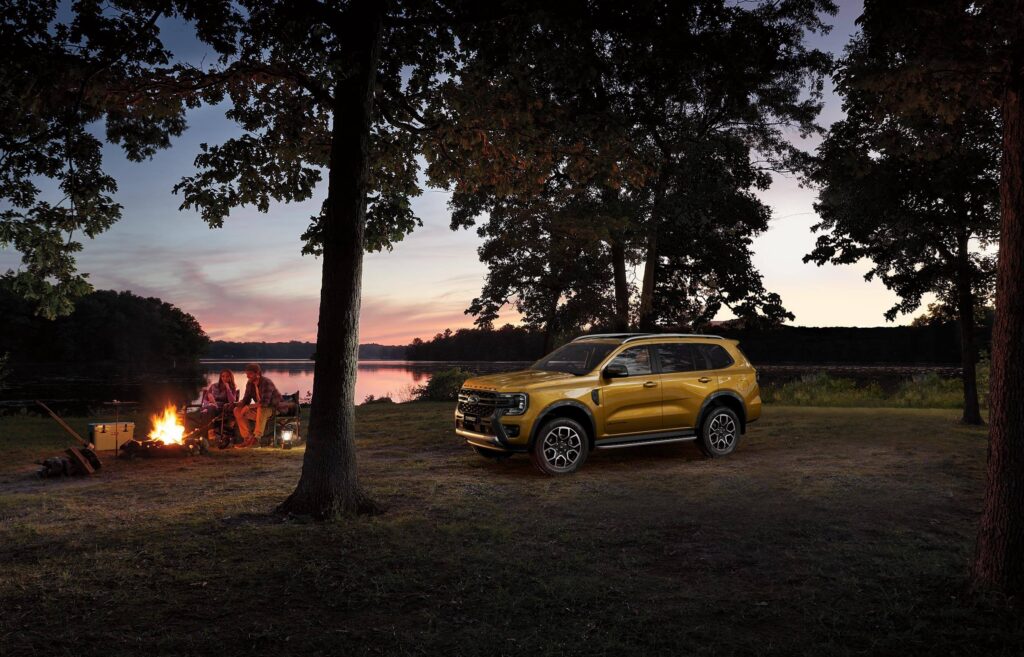
The big news is the addition of a Wildtrak spec which sees the Everest gaining the designation most buyers have, up to now, only got on the Ranger bake. This Wildtrak model fills the gap between the Platinum spec and the Sport spec. This new addition incorporates a Wildtrak-specific bold front grille with horizontal bars and a tough mesh painted in signature ‘Bolder Grey’. This liquid-like metallic accent colour is also applied to the front bumper design which is unique to this model, and provides an eye-catching contrast to the ‘Super Alloy’ silver finish of the front bash plate which houses dual recovery points and hints at the additional underbody protection fitted as standard on the high-spec four-wheel drive models (available as an option on the other 4×4 models). The C-clamp headlights with their trademark LED daytime running lights, complemented by full LEDs for the headlights, fog lamps and tail light clusters come standard.

Striking machine-faced two-tone 20-inch alloy wheels with 255/55 R20 tyres are standard on the Everest Wildtrak, but customers can option 18-inch rims and 255/65 R18 all-terrain tyres should they be more inclined to venture off-road on a regular basis. Added visual appeal is provided by the bright-finish side steps, stand-off roof rails and privacy glass, while an additional paint colour, Luxe Yellow, is exclusively available on the Everest Wildtrak.

Another new addition to the Everest range is the XLT series, which is the least expensive model in the line-up, making Ford’s exceptional seven-seater SUV accessible to a broader range of customers. The Everest XLT is distinguished by a classy chrome finish for the horizontal grille bars, offset against colour-coded treatment in key areas such as the door handles and mirrors. Privacy glass is provided from the rear windows backwards, and it shares the same high-tech full LED treatment for the daytime running lights, headlamps, fog lights and rear clusters as the high-spec models.

The cabin retains the same design and layout as seen on the current Everest models. In Wildtrak execution the interior gains additional sporty flair courtesy of contrasting yellow stitching on the dashboard, door trims, steering wheel, gear lever and the comfortable yet supportive premium leather seats that incorporate the Wildtrak logo on the eight-way power-adjustable front seats. The Wildtrak features the high-end full colour 12-inch touchscreen that operates the latest-generation SYNC 4A infotainment system with wireless Apple CarPlay and Android Auto, an eight-speaker sound system, USB-A and USB-C connectivity and charging ports, a wireless charging pad that provides cable-free charging for compatible smartphones and a built-in 400W/240v inverter.

A dark roof lining along with the dual panel powered Moon Roof further enhance the upmarket ambience. The Wildtrak is equipped with a dedicated off-road SYNC screen and a rotary Drive Modes control that accesses six settings: Normal, Eco, Tow/Haul, Slippery, Mud & Ruts, and Sand. It also features an impressive range of driver assistance technologies as standard, comprising Adaptive Cruise Control with Stop & Go and Lane Centering, Blind Spot Monitoring with Trailer Coverage, Cross Traffic Alert, Evasive Steer Assist, Lane Keeping System with Road Edge Detection, Pre-Collision Assist, Reverse Brake Assist and Tyre Pressure Monitoring System (TPMS). Also available on the Everest Wildtrak as an option is Ford’s Active Park Assist 2.0 with full autonomous parallel and perpendicular parking, in combination with the 360-degree camera system that replaces the standard rear-view camera.

The Everest Wildtrak is powered by Ford’s 3.0-litre V6 turbodiesel engine which is shared with the range-topping Platinum model. It produces 184kW and 600Nm, and is mated to Ford’s advanced 10-speed automatic transmission which uses the innovative electronic E-Shifter. The Wildtrak Everest boasts a permanent four-wheel drive system that uses an electronically controlled on-demand two-speed electromechanical transfer case (EMTC).

The Everest XLT is powered by Ford’s 2.0-litre Bi-Turbo diesel engine that is shared with the Everest Sport. This engine produces 154kW of power and 500Nm of torque, combined with the 10-speed automatic transmission. In XLT specification the Everest is available in a choice of two-wheel drive or four-wheel drive versions.
Ford has bolstered the Everest Sport offering with the addition of a 4×2 model to complement the existing 4×4 version – both of which are powered by the 154kW/500Nm 2.0L Bi-Turbo diesel engine in combination with the 10-speed automatic transmission. The Everest Sport 4×2 is ideal for owners that don’t venture far off the beaten track.
The two-wheel drive Everest Sport is visually identical to the 4×4 model, including the extensive use of black as a recurring theme for the front grille, mirrors, roof rails and stylish 20-inch alloy wheels.
Pricing (includes VAT):
Everest XLT 2.0L BiT 4×2 10AT R 832 400
Everest XLT 2.0L BiT 4×4 10AT R 896 300
Everest Sport 2.0L BiT 4×2 10AT R 918 500
Everest Sport 2.0L BiT 4×4 10AT R 984 800
Everest Wildtrak 3.0L V6 4WD 10AT R 1 084 000
Everest Platinum 3.0L V6 4WD 10AT R 1 146 500
Included as standard is a four-year/120 000km warranty, four-year/unlimited distance Roadside Assistance and five-year/unlimited distance corrosion warranty.
The recommended service interval is 15 000km or annually, whichever occurs first. The service plan has been unbundled from the vehicle price, which allows for customers to have the option of purchasing 120 000km service or maintenance plan for R23 000.
Also available at an additional cost is an extended service or maintenance plan of up to eight years or 165 000km. The warranty can be extended up to seven years or 200 000km as well, while the Roadside Assistance can also be extended for an additional one or two years. Terms and conditions apply.