

Minimising rolling resistance has become one of the most important goals in the world of tyre development. The key goal for tyre and vehicle manufacturers is to ultimately reduce fuel consumption, extend the driving range and carbon emissions in vehicles equipped with internal combustion engines, hybrids and electric vehicles.
One of the biggest contributors to rolling resistance is the energy loss generated in the form of heat, which is called hysteresis. This is the result the vehicle’s weight making the tyre bend and flex constantly. This deformation is also influenced by the tyre pressure, vehicle speed and road surface characteristics which cause the engine or electric motor has to make up for lost energy.
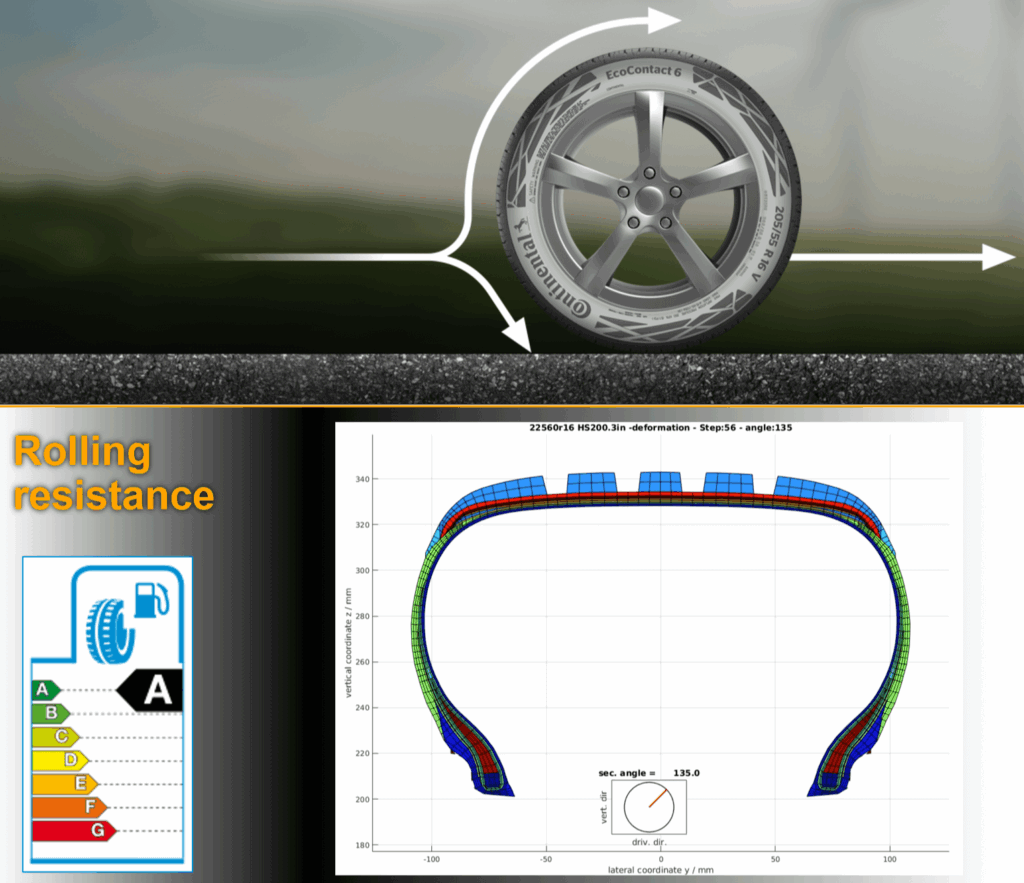
To combat this, many tyre manufacturers use specific rubber compounds and tread designs to control hysteresis, with low-hysteresis tyres being designed to improve fuel efficiency.
Conflicting goals in tyre development
While reducing rolling resistance involves avoiding and lowering energy losses, this is very different when it comes to braking. You see, when braking a tyre needs to cool down in order for it to slow down but this is hard to do when road conditions are wet.
In wet weather, energy is only lost if the rubber absorbs a lot of energy while braking. These two opposite needs – less energy loss during normal driving and more during braking – create a conflict. So, when making new parts, tire makers must consider both to keep performance high in both situations.
Developing energy-saving tyres
The development of concepts for “energy-saving tyres” goes back to the energy crises of the mid to late 1970s. In 1980, working in collaboration with and with funding from the German Federal Ministry for Research and Technology, Continental started work on a fundamental study into the design and material-related variables impacting the rolling resistance of commercial vehicles.
Over the same period, Continental’s car tyre research team created the “cap-and-base” design, which uses tough tread materials on top and shock-absorbing materials underneath. This helps lower rolling resistance by up to 15 percent. Once the basic study was finished, Continental launched a large-scale R&D project codenamed EOT (Energy Optimized Tire) in 1982 with the ultimate aim of developing a tyre with 25 percent less rolling resistance and a 30 percent longer service life.
Other technical milestones on the road to the efficiency-optimised tyre included the flat belt concept and finite element method. In 2011, and aimed specifically at the growing market for electric and hybrid vehicles, Continental unveiled the Conti.eContact, the first tyre of its kind to be designed according to the “tall and narrow” principle. It was slimmer than conventional tyres, but had a relatively large diameter.
Since 2020, Continental has been shipping original equipment tyres that are another 20 percent more efficient than the standard class of European tyre label “A”. This innovation was supported by, among other things, the “Green Chili 2.0” rubber compound, which ensures lower energy absorption through the tyre on contact with the road – without any compromises on any of the relevant conflicting goals.

Continental has expanded this philosophy across its range, with all of its sixth and seventh-generation products in the Continental tyre portfolio optimised for all drive systems – from internal combustion engines to hybrids and EVs. All new tyres launched since 2023 feature the “EV-Compatible” logo on the sidewall.
Lower rolling resistance means reduced energy consumption
From a sustainability point of view, it doesn't matter if tires are used on gas-powered or electric cars. The important thing is to use less energy. This means gas cars use less fuel, electric cars can drive farther, and as long as the electricity for charging isn't all from renewable sources, both types produce fewer emissions overall.