
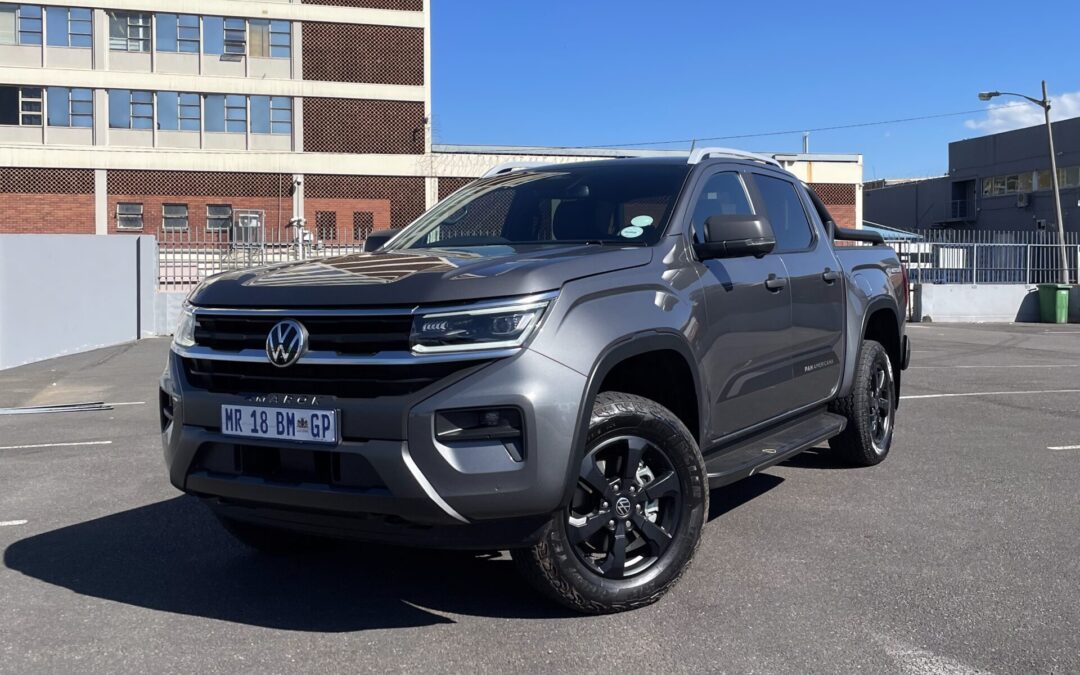
What happens when you simply feel that the Toyota Hilux GR just doesn't chap your hide, or if the recent fuel increase has made you decide that maybe a Ford Ranger Raptor needs someone who has tenders deals backed up until the year 2028? Well, Volkswagen has entered the chat with their rendition of an unnecessarily powerful bakkie worthy of the GTI nameplate : it's the 222 kW Amarok Pan Americana, and it moves.
The Pan American grade sits just below the top of the range Adventura model trim, which is a glitzy and glamorous lifestyle-oriented bakkie for those who would quite literally never even go over the pavement in any case. But if you are one for rolling your sleeves up and don't mind getting your hands dirty in a matter of seconds, you have to go for the Pan Americana spec, which is obviously your road less traveled trim that has bulky tires, more cladding than you would need, and a figure of 0- 100 km /h in just 7.9 seconds Huh?

An update in the range saw the addition of the new, most powerful engine that you can equip your Amarok with.
Yes, the model range was previously available with just two engine options, which were the 2.0 BiTurbo diesel Ford-sourced engine or the newer, also Ford-developed, 3.0L V6 TSI engine, which is still all the rage. However, in late 2025, Volkswagen decided to add a more fun and quicker engine option in the form of a 222 kW 2.3-litre TSI turbocharged petrol engine as a new high-performance flagship option. This is again the same 2.3-litre EcoBoost unit used in the North American Ford Ranger and Ford Focus/Mustang, produced for the Amarok through the Ford-VW partnership.
Being one of the top of the range means you get a fair amount of standard equipment with less to tick off, like the "Cricket" Leather Seat Package, Driver Assistance Package 8, and Infotainment Package 6, which means the car can take on a semi-autonomous level of driving when the active cruise control is turned on (radar monitoring and all that), and that the car is safe.

A quick look at the exterior appearance of the vehicle, shall we?
Our unit was finished in a Dark Grey Metallic hue that contrasts well with the Black "Amadora" wheels, giving the vehicle a mean, rugged appearance. On top of that, the vehicle has model-specific decal and stickers that flank the doors, labeled "Pan Americana," and some that say "4 Motion," just to remind onlookers that this is a rugged, purpose-built 4x4 bakkie. Although I do feel that for this one, there should have been some 222kW badging here and there to signify its stature, but maybe that's just me.

A top touch would have to be the electric garage lid that closes and opens either by double pressing your key fob or by clicking a button on the dash below the steering wheel to cover all of your loaded sand, equipment, or groceries in the loading area that can take up to ~1.16 tonnes (1,160 kg). In the rubberized loading bay, you also benefit from built-in adjustable tie-down anchor points and some 230V power outlets to connect power tools when you are working on the move. The rear of the vehicle also benefits from these blacked-out sports bars that cost you R24,437.50 because as standard, you either don't get any sports bars or they are in chrome.

The ride comfort is unmatched for sure.
This vehicle hands down has one of the softest rides I have ever experienced from a bakkie-based vehicle, which is often a ladder-on-frame chassis that wobbles and thuds about. It's made to handle more harsh abuse to the suspension from various uneven terrains without unsettling the balance of the car and, well, without it breaking. In the Amarok, however, you would almost forget at times that you are driving a big heavy weight (around 2,300 kg to be exact). In fact, the only time you are reminded that you are in a bakkie is when you have to brake, and the lumpy feeling brakes make the big car lean forward as physics does its thing when you come to a stop.

The Amarok was always sought to be the closest thing to a SUV or normal car in terms of driving feel but it seems sharing the T6.2 platform alongside the 2nd-gen Ford Ranger has upgraded that fact without of course losing the mean, utilitarian feel we all really want from a bakkie. My point of reference as a means of comparison would be the Kia Tasman which I recently drove at a launch over three days, to be fair it is a fairly new product and a first for the brand but they managed to still make it feel like a bakkie with just enough hint of softness in the ride - the Amarok still trumps it though for ride softness, no doubt.
Steering the vehicle was easy too ; it felt less like the labour you would experience trying to conduct a U-turn in, say, a Hilux. As for putting a petrol engine in a car this big, I obviously had concerns from a livability perspective. Yes, the car is touted to be a GTI and achieve bonkers acceleration, but what is it like on a daily basis ? Don't get me started on the fuel consumption woes; I had anxiety about.
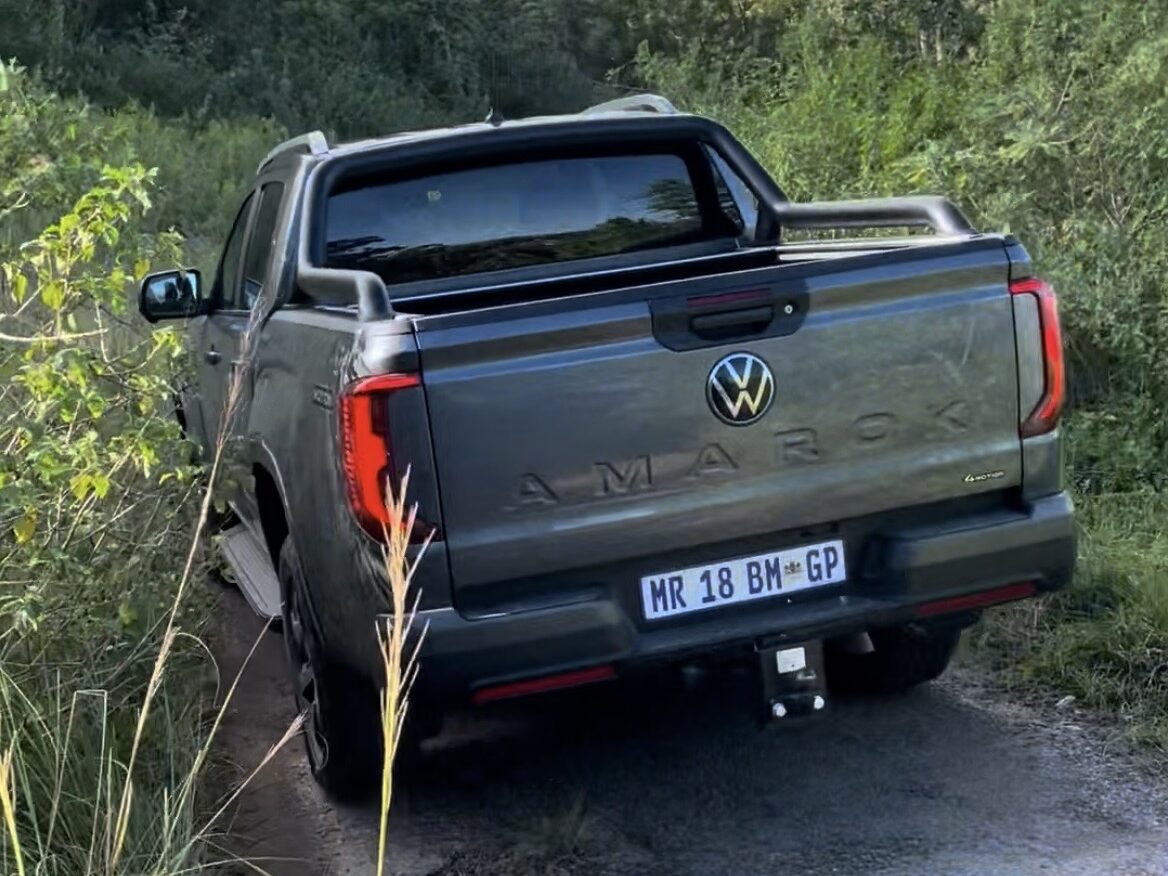
Does the petrol engine feel like a mismatch for this car?
It surprisingly didn't once feel under powered as it always just found a gear and reached in its torque band to provide forward propulsion (I learnt that word from a science movie), I mean if there's 10 to choose from then of course it would be easy to find a gear, but simply put, it managed its weight well on straights in terms of acceleration, on inclines with passengers and I had a short cut on my way home to test off road behavior and it did very good on a light bit of dirty, rocky uneven pathway I put it on. Yes, you can't exactly mimic the display of torque a diesel engine puts out at just a nudge of the gas pedal because in the petrol you had to squeeze the padel a bit more just to get the vehicle to creep forward but once in motion? no problem.

It is certainly a kind of GTI embodiment.
In terms of performance display, this thing is an absolute monster because it just devours the road once you put your foot straight to the floor. It is an experience I can only describe as impressive yet morbidly scary because a car that big really shouldn't be able to achieve the speeds that this car can reach. I can really imagine what it's like driving a Ranger Raptor, but since petrol prices keep going north, I will only have to imagine. Speaking of fuel hikes, a full fuel tank for the Amarok should cost about R1,158 (before the price increases experienced in May), and Volkswagen claims that this car produces a fuel average of 9.7 L/ 100 km. While I was not even trying to misbehave, I got a fuel reading of 13.1 L per 100 km, which was the lowest for me, and I tried a bit.

The interior lacks a bit of VW-ness for me, can we have some more of that?
The interior is a bit of a dividing factor for me. The elephant in the room is that this car shares a platform with the Ford Ranger, and this means there is largely a huge presence of parts sharing, all in an effort to improve production capacities at faster speeds and lower costs. All understandable, but this does take away a sense of identity for the Amarok nameplate. It has the same horizontal layout 12-inch display as the Ranger, the same gear lever, and the same driver display panel, but obviously, the VW team did try their best to incorporate some touches to make it differ from the other one.

I like the tweaked layout of the dashboard ; although the underlying dashboard skeleton is shared, they did add their own graphics to the display screens because seeing a Ranger in an Amarok would be blasphemy. They have added a touch of typical Volkswagen-ness as the vehicle's seats are very comfortable, in the Pan Americana, the seats are finished in a two-tone Black-Anthrazite-Brown scheme. I find this color scheme weird because if you change the exterior color to, say, red or white, the interior just stays like that.
I also was not a fan of the door bin sizes for the front ; they were too small and could barely fit a coffee flask, but I bet a smaller water bottle could fit in there no problem. On the other hand, the car did come equipped with all - weather floor mats for the front and rear seats, so the car does not get dirty easily if you go mud skipping, which is a big plus in my book. I was also a fan of the Harmon Kardon sound system, the 10-way electric adjustable seats that are heated, and the way you open the door from the inside, which is a neat party trick.

The 222kW Amarok makes sense.
So then, if you are an enthusiastic driver and a literal petrolhead, here is a car that ticks all the boxes of a traditional bakkie by being capable and practical, with the benefit of onboard comfort and refinement. It is one of those cars that has cemented its name in the segment, although it has faced some challenges in recent times with the entrance of various players in the game. The charts show that it hasn't been the strongest in a while, having fallen off the top four best-selling bakke in Mzansi to no.7. That shouldn't deter you from buying it at all ; it will always be the key example of a bakkie that looks great, rides like an SUV, but has the tools to traverse the most treacherous terrains against all odds.

In the space that it competes in, which is around the one million rand mark, this car costs R1,099,000.00 (R1,123,437.50 as specced with the mats and black sports bar). This means you play within the realms of Ford Ranger Tremor territory, which kicks off at R1,039,000 or the 2.8 GD-6 4X4 GR-S 6AT, which starts at R1,009,000. Stiff competition for sure in its segment, but this car, especially in this guise, is worth a look because who wouldn't want to have a GTI Amarok.