

The highly anticipated and, judging from press release images in the context of exterior appearance, most hated bakkie has launched in South Africa, and it is from a very unlikely brand. Korean stable Kia has launched their first ever bakkie that is slated to be after the beloved Mzansi holy-bakkie trinity: the Ranger from Ford, Toyota's Hilux, and the one and only Nogwaja D-Max from Isuzu.
Tall ask to say the least, but Kia pulled a "Hold my drink" moment by taking us on a three-day trip to properly decipher whether this new Tasman can even hold a flame to the competition. Through a grueling but light trip on the most beautiful back roads the Western Cape has to offer, we set out to challenge the car through shoddy gravel routes, truck-infested national highway routes, and a combination of some city/town driving.

Before I tell you how it drives, I must first inform you that this car is assembled in our specific line at the Hwasung Factory, which means it is a new vehicle from the ground up. However, you must remember that this wouldn't be a foreign endeavor for a brand that is absolutely rocking the small commercial truck segment in the form of the K200 truck. The Tasman has a ladder-on-frame chassis setup (the first great tick for a bakkie must-have) that is paired with double wishbone front suspension and a rigid rear axle with leaf springs.
For some more technical details, the Tasman has a gross vehicle mass of approximately 3,250 kg and a gross combined mass of 6,200 kg - Good numbers already considering that the Hilux from Toyota should also have a gross of around between 2,600 kg and 3,210 kg. Kia reckons the Tasman can withstand a payload capacity that exceeds one tonne, while comprising of a braked towing capacity of around 3,500 kg.

Fun fact, the Tasman measures at 5 410 mm in length and has a wheelbase of 3 270 mm, which might mean it is roughly 60 mm longer than a Ford Ranger, making it one of the largest in its segment.
Powering the Kia Tasman is a 2.2-litre SmartStream turbodiesel engine, delivering 154 kW of power at 3,800 rpm and 440 Nm via an 8-speed automatic that apportions power to either the rear wheels or all four wheels. This selection and allocation of power is thanks to Kia's dedicated smart transfer case and the X-Trek systems, which "allow for low-speed progress over rough terrain, reducing driver workload and improving confidence when the going gets tough."
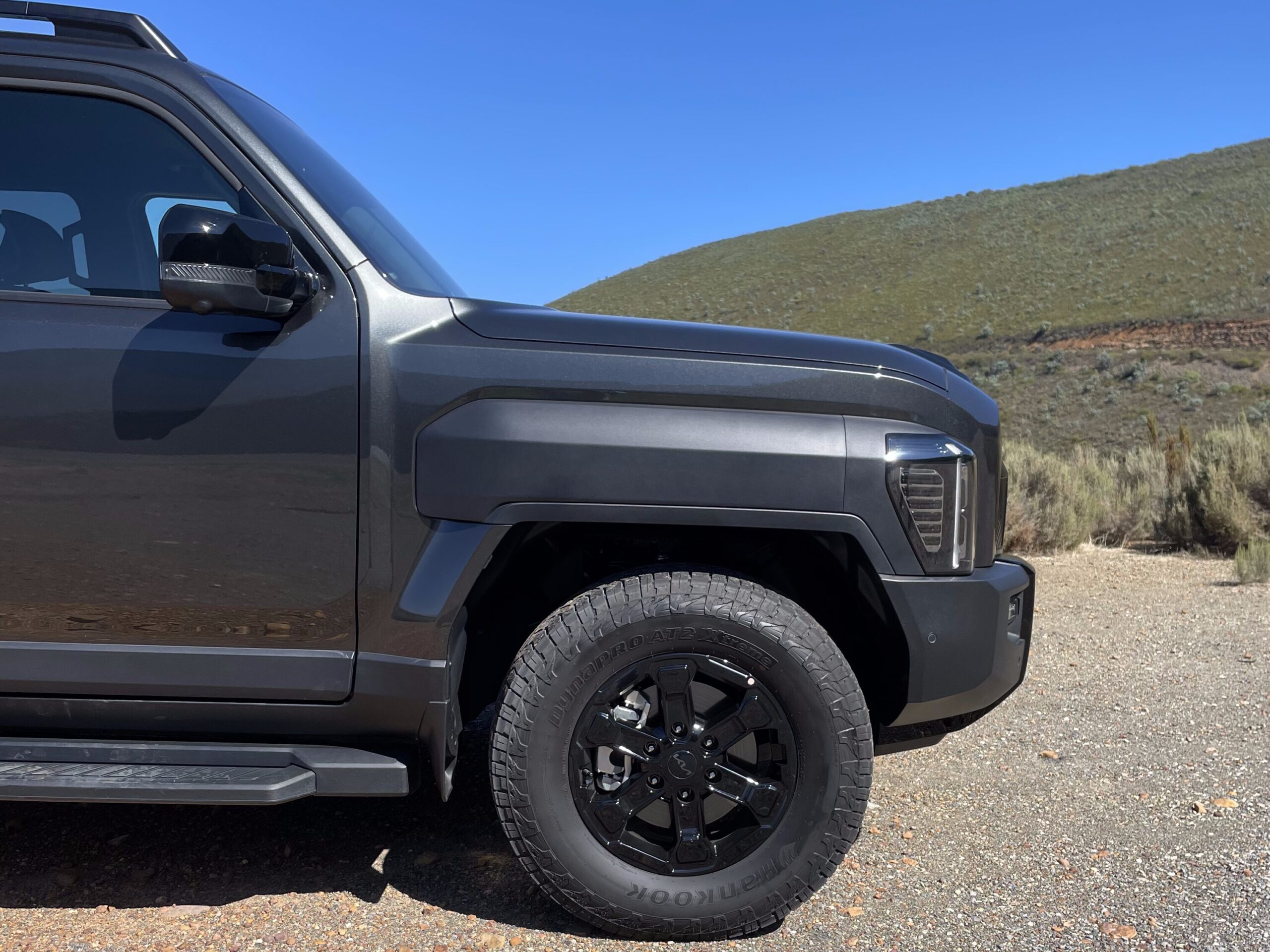
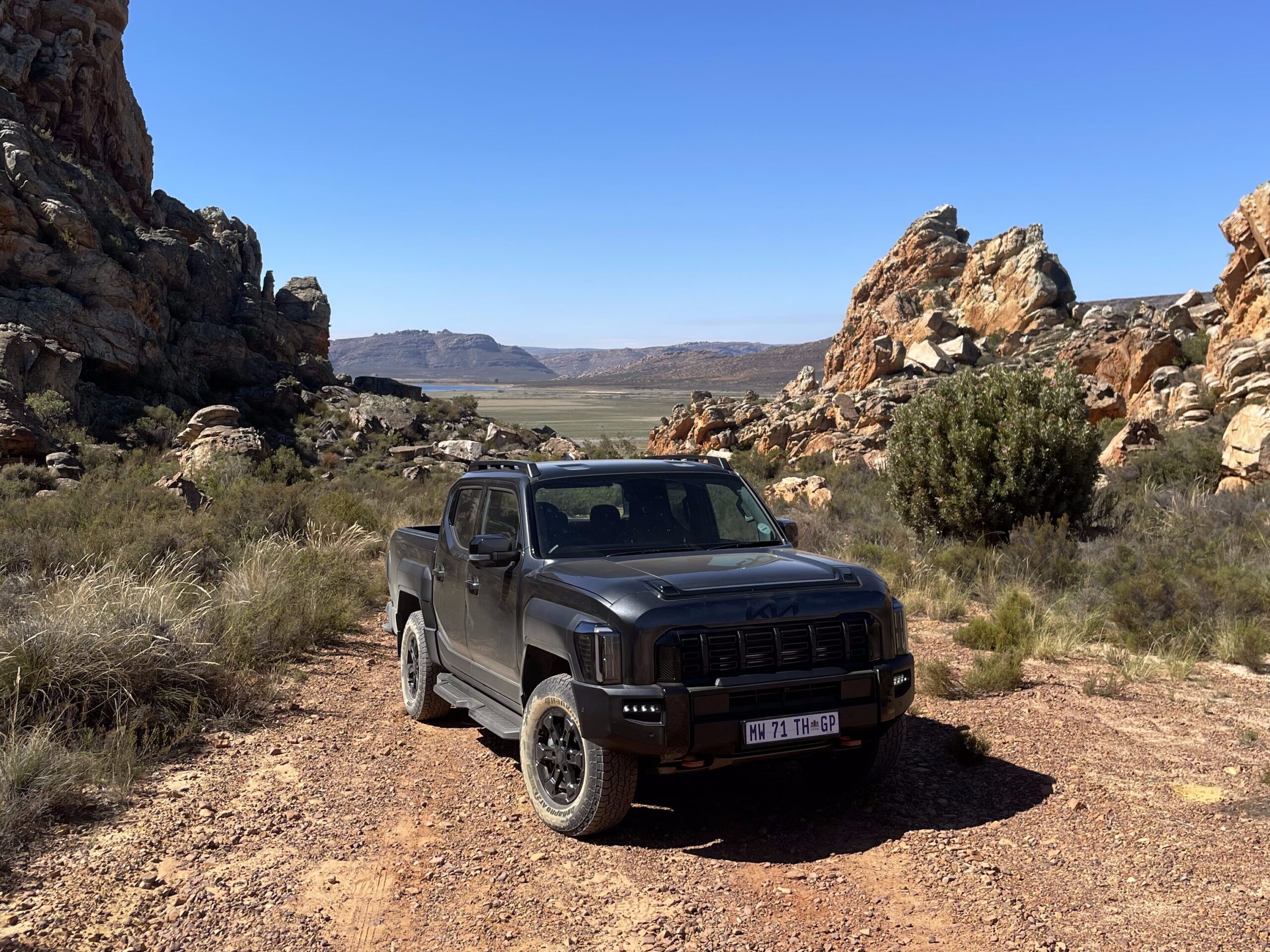
Let us talk about the look of the vehicle. Let me start off by saying that the press images and videos do not do the car any justice because the car absolutely looks menacing! The obscure Lego-like design has sharp edges and elements that provide the car with a whole mean stance, but one must stay away from choosing a white color, as this strips the edginess of the design.

On the exterior, you find a huge bonnet that dominates the front of the vehicle, which is flanked by smaller horizontal lights that look like they are placed on the side of the front as opposed to being right on the front. The side profile, with a ground clearance of up to 252 mm and a wading depth of 800 mm, has large wheel arches that accommodate chunky rubber, while the raised lower bumper with dual integrated tow clamps provides you with approach angles of up to 32.2° and , for the rear, departure angles of up to 26.2°.

Speaking of rear, this is where the car looks a bit normal and rather a bit familiar, squint your eyes and there hints of Jeep Gladiator going on and with the brake lights on in the fair? it kind of looks like a Hilux Legend 55 from a far.
Jump inside, and this is where this bakkie might be showing earlier signs of knocking the competition . Most of the cars in this segment have zero focus on the interior most of the time, often leaving this space to be mild or just practical enough. Not Kia, because, like the Ranger, they have made an effort to prioritize ride comfort, tech, and features.
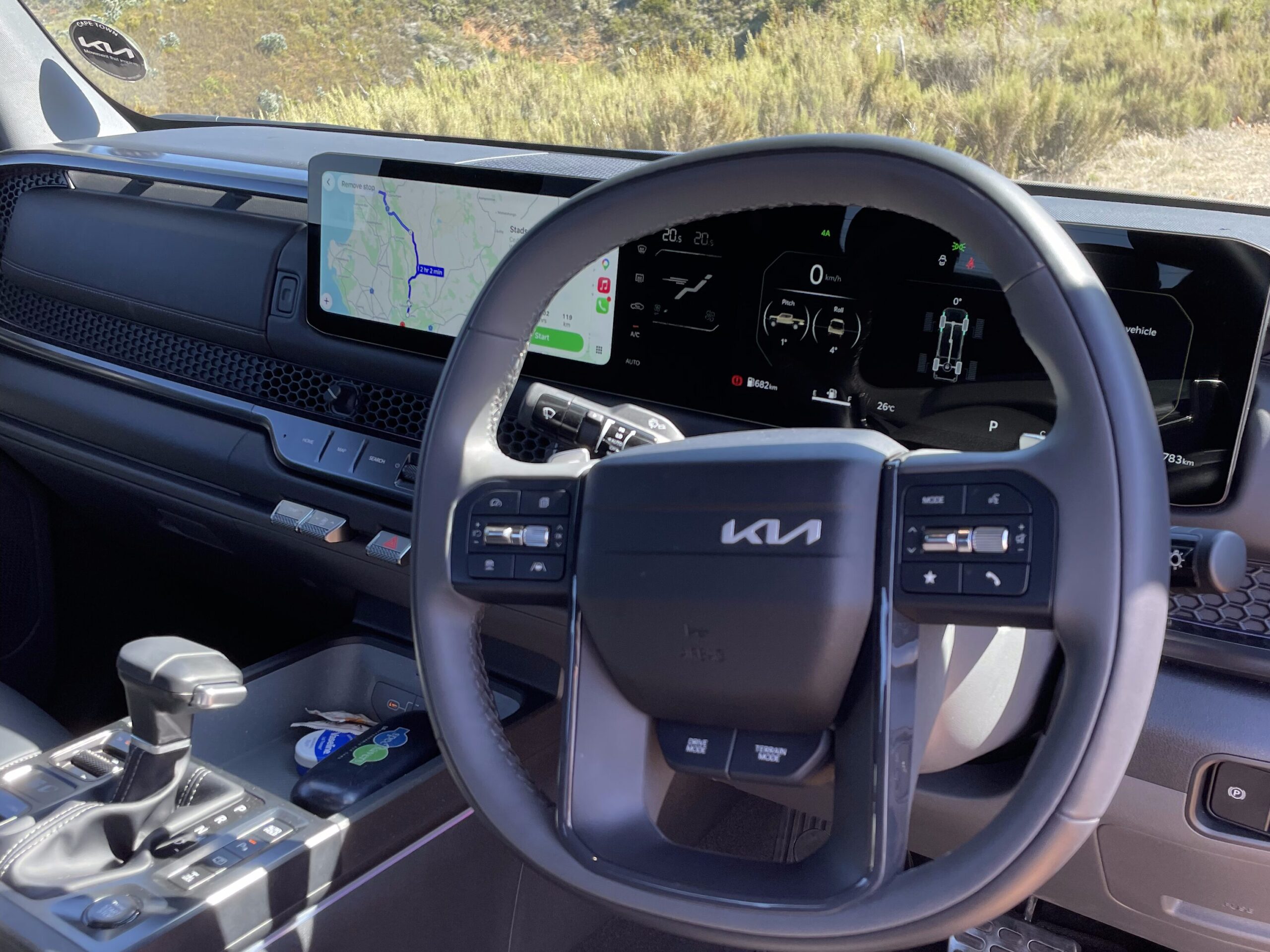
Some highlights of the interior are the fully integrated digital display setup - combining a 12.3-inch driver cluster, a central infotainment screen, and a dedicated climate control interface. The infotainment pumps music through an optional Harman Kardon sound system on the top-of-the-range models, while the driver's display benefits from various vital information displays, such as tire pressure, approach angle, and even how far tilted your vehicle is if you're off-roading. Range-topping models benefit from leather seats that are heated and ventilated, a multifunctional steering wheel, and multiple charging ports scattered throughout the cabin.

You can also expect that this car is equipped with the latest safety sense systems and ADAS functions, from adaptive cruise control and lane-keeping assistance to blind-spot monitoring and autonomous emergency braking. Some other features found in the Tasman range include rain-sensing wipers, a surround view 360 camera, electro -chromatic rearview mirrors, and parking and proximity sensors.

The drive. We set out to Lambert's Bay from the city center of Cape Town to embark on an almost 300-plus-kilometer road trip to get better acquainted with the car. It quickly showed high levels of ride comfort and a fairly quiet cabin, maybe thanks to the extensive engineering that went into improving the NVH levels of the Tasman, as there was practically no wind noise entering the cabin, with just a little bit of the diesel motor's churn seeping into it. Also commendable was the smoothness of the gear shift - we drove into a long gravel patch to test out the different modes for 4H, which provided much more grip and long gear changes , as the car felt solid and gave the drive a sense of confidence, even on the often unpredictable gravel roads.
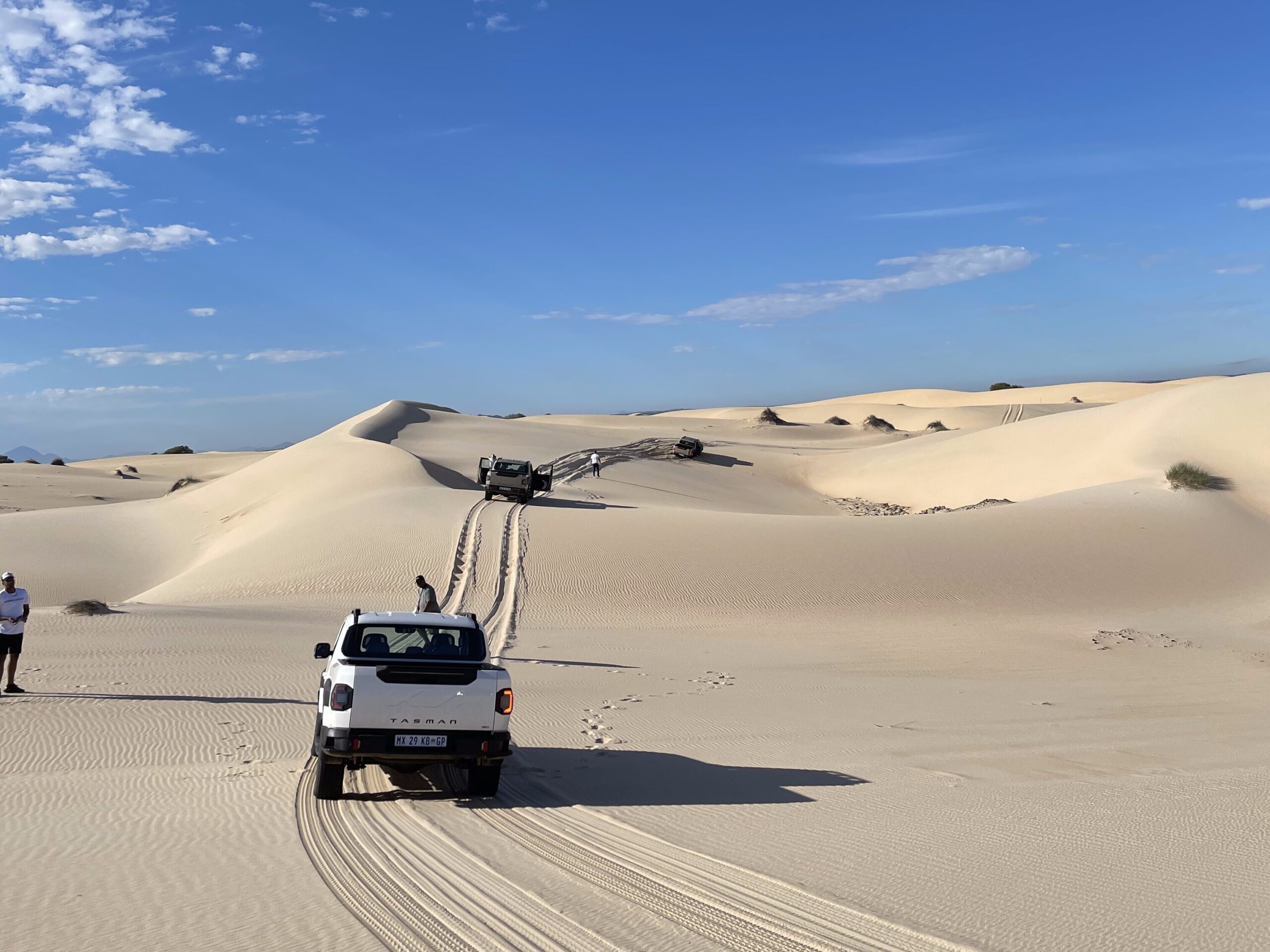
Our trip also saw us tackle a dune to test out the sand mode setting. With our slightly deflated tires, we hit the dune land to see what this Tasman had up its sleeve, and I am glad to report that it did quite well, leaving a smile on my face. Now, I am no expert on bakkie off-roading and dune driving, but this car did a great job showcasing that it is capable, up for the task, well-built, and solid. Might we see a turn of direction for the SA bakkie lovers? We have seen some unlikely or rather surprising bakkies, like the Mahindra Scorpio and Foton Tunland, making the list of best-selling bakkies in SA.
The new Kia Tasman range is priced as follows:
Kia Tasman 2.2D AT 4x2 LX R 679,995
Kia Tasman 2.2D AT 4WD LX (COLOUR CODED) R 684 999
Kia Tasman 2.2D AT 4WD SX R 879 99
Kia Tasman 2.2D AT 4WD SX (COLOUR CODED) R 884 999
Kia Tasman AT 4WD X-PRO. R 999 995
Kia Tasman 2.2D AT 4WD X-PRO (COLOUR CODED) R 1 004 999
It was interesting to note that the Tasman will only be available in double cab guise for now however due to the strategic planning and assessment of the performance of the bakkie in "how it will do in the South African landscape" from the Korean automaker, they shared to the media that there is definantly a real possibility for more various body styles and possibly other engine options to fill the Tasman locally.